

Key Takeaways (TL;DR)
- The pursuit of short-term cost reduction and the proliferation of non-regular employment have depleted the stock of human capital, a critical social infrastructure, consequently leading to a decline in labor productivity.
- Exceeding a specific critical threshold (20% to 40%) in the ratio of non-regular employees leads to a concentration of escalations, overwhelming the processing capacity of regular employee nodes and triggering cascading failures.
- The fundamental issue stems from a misjudgment in organizational architecture design by management, who erroneously assumed that humans could be standardized and procured as interchangeable 'modules (APIs)'.
The World's Strongest "Genba" Hollowed Out in the Shadow of the Physical AI Boom
As the next phase following generative AI's sweeping impact on knowledge work beyond the screen, "Physical AI" and humanoid robots operating in the real-world physical space are emerging at the forefront of global industry. In this convergence of robotics and advanced machine learning, investors and technology companies worldwide are once again keenly observing Japan's manufacturing sites—its "monozukuri" foundation—which have long enabled highly intricate adjustments and "suriawase" (fine-tuning and integration), from semiconductor manufacturing equipment to precision machinery and the automotive industry.
The world appears to be re-evaluating Japan as an "ideal proving ground for collecting precise physical space data and integrating it with AI." However, upon stepping into these very Japanese workplaces, the reality that unfolds is far from optimistic.
"Even if we try to introduce robots and the latest smart factory equipment, there are no longer enough people left on the ground who can implement them and respond to the subtle errors that occur daily."
A veteran engineer at a major precision equipment manufacturer laments this. The very workplaces that have long underpinned Kaizen and site-driven innovation have, over the past three decades of drastic labor cost reductions and the expansion of non-regular employment, become hollowed out and depleted. Why are Japanese companies, which have amassed unprecedented retained earnings and supposedly achieved "rational management" on their Profit & Loss statements, now suffering from severe labor shortages, repeated quality scandals, and a form of "autophagy" in the name of long-term stagnation on the shop floor?
The key to unraveling this immense paradox lies in management's fatal illusion that humans can be treated as "interchangeable external modules (APIs)," coupled with fundamental architectural design flaws within the socio-economic system. This paper will traverse topics ranging from macroeconomic trends and complex network theory to development economics and the micro-level human psychology of the workplace, examining the full scope of the "tragedy of the human capital commons" self-inflicted by the Japanese economy.
Abundant Balance Sheets and Impoverished Workplaces
The current state of the Japanese economy is defined by an anomalous, bipolar contrast: the overwhelming "wealth" of corporate finance versus the "poverty" of competitiveness and productivity on the ground.
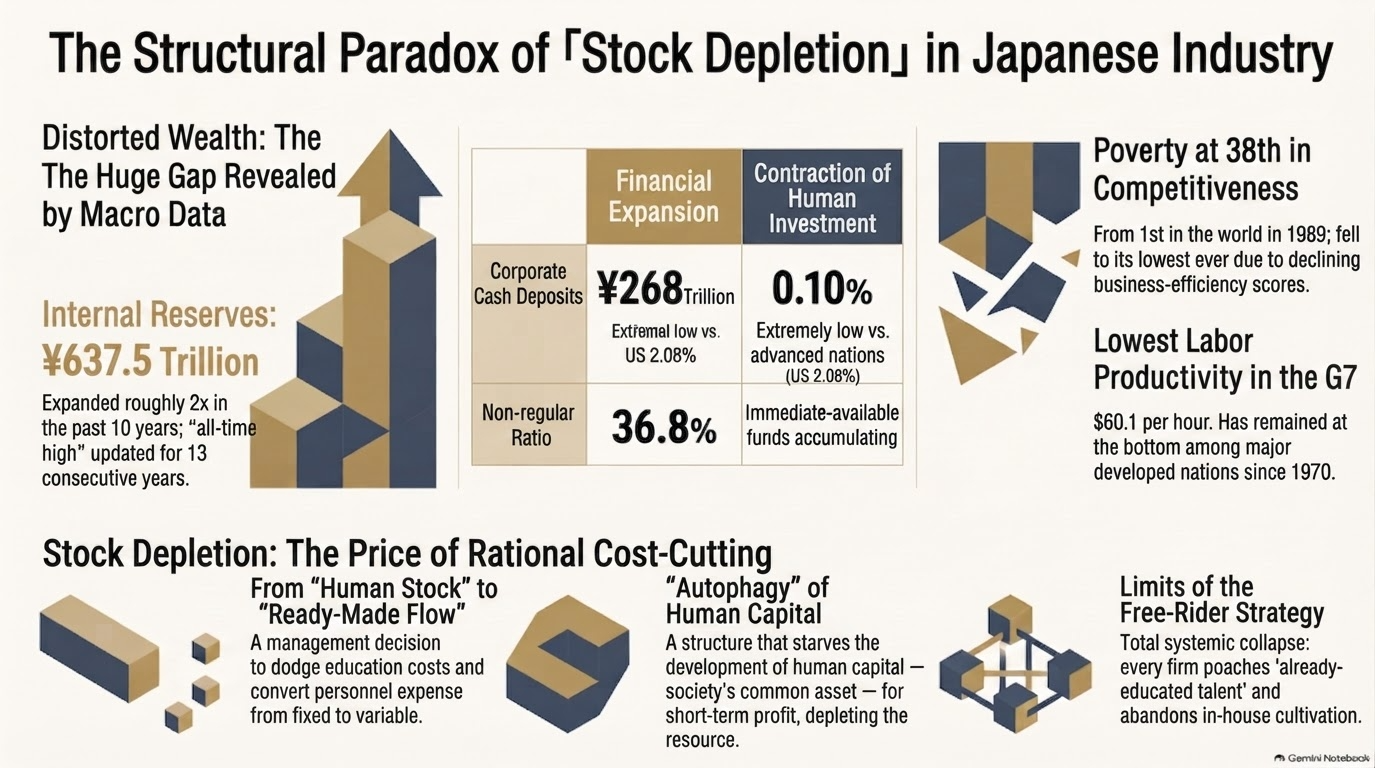
| Indicator Category | Latest Figures and Ranking | Data Background, Long-Term Trends, and Structural Implications |
|---|---|---|
| Corporate Retained Earnings (Earned Surplus) | 637.5 Trillion Yen (FY2024) | According to the Ministry of Finance's "Financial Statements Statistics of Corporations by Industry," this marks a record high for the 13th consecutive year. Readily deployable cash and deposits alone amount to 268 trillion yen. |
| Corporate Investment in Human Resources (excluding OJT) as a % of GDP | 0.10% | According to the Ministry of Health, Labour and Welfare's "White Paper on Labour Economy" and other sources, this figure is extremely low compared to developed nations like the U.S. (2.08%) and France (1.78%), ranking among the lowest for major countries. |
| Labor Productivity per Hour | 60.1 USD (5,720 JPY) | According to data published by the Japan Productivity Center, Japan ranks 28th among 38 OECD member countries. Among G7 nations, it has consistently held the lowest position since 1970. |
| IMD World Competitiveness Ranking | 38th (2024 edition) | A significant decline from its world #1 ranking between 1989 and 1992. Evaluations for "Business Efficiency" and "Management Practices" have been particularly sluggish. |
| Proportion of Non-Regular Employees | 36.8% (approximately 21.26 million people) | Ministry of Internal Affairs and Communications, "Labor Force Survey" 2024 results. Continuously rising from around 10% in the 1980s, it doubled and became structural, reaching approximately 40% over the 30 years of the Heisei era. |
Macro-level Self-Cannibalization Born from Micro-level Rationality
This enormous divergence is by no means an accidental economic fluctuation. Its historical genesis can be traced back to the 1995 report "Japanese Management in a New Era," presented by the Japan Federation of Employers' Associations (Nikkeiren), following the appreciation of the yen after the 1985 Plaza Accord and the collapse of the bubble economy in the early 1990s.
This report proposed the concept of an "employment portfolio" as a guideline for navigating an era of low growth. It posited a three-tiered model for the workforce: "Long-term Accumulated Capability Utilization" for executive candidates subject to traditional lifetime employment and seniority-based wages; "Highly Specialized Capability Utilization" for those flexibly employed for their expertise; and "Flexible Employment (Non-Regular Employees)" such as part-timers, contract workers, and temporary staff, who served as a buffer for performance fluctuations.
In response, a torrent of deregulation in labor laws ensued, including revisions to the Worker Dispatch Law in 1996 and 1999 (liberalizing dispatch-eligible work). Coupled with the suppression of new graduate recruitment after the bubble burst (creating a "job-hunting ice age"), the proportion of non-regular employees among all workers surged from approximately 20% in the early 1990s to about 40% in the 2020s.
For management, the shift to non-regular employment was an "eminently rational business endeavor." It allowed them to avoid the fixed costs of personnel expenses, transforming them into "variable costs" adjustable according to performance fluctuations. By assigning only specific, manualized tasks, companies reduced long-term training costs and welfare expenses. The actions of individual companies, aiming to optimize their profit and loss statements (P/L) and considering educational investments in highly fluid non-regular workers as "unrecoverable losses if they transferred to another company," were 100% rational from a short-term, micro-level perspective.
However, what transpired for society as a whole when all players simultaneously pursued this partial optimization? While individual companies' financial statements (P/L) were meticulously polished, and internal reserves accumulated to a staggering 637.5 trillion yen, the "Human Capital Management (HCM) accumulation (stock)," a common social infrastructure, became depleted. This generated a devastating macro-level negative externality: the erosion of Japan's overall labor productivity.
System Thinking Unveils the Causality of Self-Cannibalization
"Is not the unpredictability of the business environment (VUCA) the primary cause of declining productivity, with the internal factor of non-regularization playing a minor role?"
This counter-argument, frequently voiced by top management and macroeconomic analysts, is a remarkably convenient narrative for externalizing corporate responsibility. Undeniably, over the past three decades, external environmental complexity has dramatically increased with the digital revolution, the rise of AI, and the ascent of emerging economies. However, system theory and global data analysis clearly expose the logical fallacy of this "VUCA causation theory."
Conclusions Drawn from Global Controlled Experiments
Firstly, the external shock of VUCA did not exclusively afflict Japan. The United States, Europe, and various Asian nations faced the explosive spread of the internet, the Lehman Shock, pandemics, and geopolitical risks on precisely the same timeline.
If "drastic changes in the external environment" were the primary cause of productivity stagnation, then all developed nations should be equally grappling with declining productivity. Yet, in reality, among OECD countries, only Japan has experienced a prolonged deceleration in productivity growth, remaining entrenched at the bottom of the G7. The decisive disparity that has occurred solely in Japan amidst common external variables (VUCA) is none other than Japan's unique internal structural variable: "the self-cannibalization of Human Capital Management (HCM) through non-regularization."
Self-Destruction of Buffers within the System
Secondly, within system thinking, the VUCA era signifies a state where "random disturbances and shocks (noise) from the external environment are continuously fed into the system." For a system to adapt and persist without collapse under such conditions, "redundancy (buffers)" and "organizational cognitive bandwidth (capacity for thought and response)" are absolutely essential to absorb shocks and address unforeseen challenges.
The traditional buffers in Japanese organizations resided in the regular employees on the ground: "close interpersonal relationships enabling mutual assistance beyond defined job scopes," "tacit knowledge for understanding context," and "autonomous judgment to resolve sudden issues on-site."
However, through rigorous cost reduction and non-regularization, Japanese companies systematically stripped away these buffers, deeming them "unnecessary costs." It is not that "productivity declined because of VUCA." Rather, "at the very moment a VUCA storm was approaching, they themselves removed the bulkheads (buffers) of their ship, transforming it into a fragile hull that would immediately flood upon encountering waves." This is the true causal mechanism.
The Innovator's Dilemma, Human Capital Edition
Clayton Christensen, in his seminal work "The Innovator's Dilemma," astutely observed that outstanding companies fail in the face of disruptive change not because their management is incompetent, but because they engage in "eminently rational resource allocation" that optimizes for existing customers and short-term profitability (flow).
The expansion of non-regular employment aggressively pursued by Japanese companies was precisely the Human Capital edition of this "dilemma." To improve quarterly profitability, tasks were broken down into smaller segments, manualized, and outsourced. In the short term and locally, this appeared to reduce costs and enhance efficiency. However, as a trade-off, organizations effectively uninstalled their "learning capability (self-transformation OS)"—the very ability to adapt to long-term change and transform themselves.
The Illusion of Modularization and the Destruction of Organizational Architecture
In recent software development and startup management, "modular development"—combining external SaaS and APIs (Application Programming Interfaces) to rapidly launch services without maintaining heavy in-house systems—has become mainstream.
The greatest illusion that Japanese corporate management fell victim to since the 1990s was the overconfidence that this IT paradigm could be directly applied to "flesh-and-blood humans and organizations."
"If tasks are standardized and manualized to the extreme, and human labor can be plug-and-play sourced cheaply from external providers, organizational agility will increase, and personnel cost risks can be minimized."
Management believed this. However, humans are not code or APIs. An API in code adheres to predefined protocols, returns deterministic outputs for given inputs, and has error-handling specifications built-in. Conversely, when living humans are integrated into an organization as "external modules" confined to specific, simple tasks, the following three fatal system failures (bugs) occur:
1. Rejection of Exception Handling
In real-world business environments, "unknown exceptions (irregularities)" not described in manuals occur routinely. Non-regular workers, treated like APIs, are granted neither the "authority" nor the "time buffer," and crucially, not the "incentive (feedback into evaluation or wages)" to handle these exceptions beyond their defined scope of work. As a result, subtle discrepancies and errors arising on-site are either ignored or entirely deferred to a small number of regular employees.
2. Discontinuity of Context
For an organization to function smoothly, an unarticulated context (common OS) such as "founding principles," "long-term business strategy," and "the value truly sought by customers" must be shared. In the layer of non-regular employees, whose employment terms are limited and turnover is frequent, this common OS is not shared. Consequently, friction costs (Transaction Cost Economics (TCE)) between departments and individuals surge, and autonomous cooperative relationships geared towards overall optimization cease.
3. Inability to Share Tacit Knowledge and Knowledge Sedimentation
Tacit Knowledge, such as "knack" and "intuition," cultivated by skilled workers through years of experience, can only be transmitted in environments characterized by long-term human interaction and high trust (social capital). In modularized work settings, knowledge remains confined to individuals, exiting the company upon their departure, leading to a complete flattening of the organizational Learning Curve.
Management that modularized and commoditized human beings, far from enhancing agility, instead created a "rigid and fragile organization" utterly incapable of responding to unforeseen circumstances.
The Overload Domino Effect and the Paradox of Physical AI Besetting the Manufacturing Sector
The most devastating manifestation of this failure of 'human API-fication' has emerged within the manufacturing sites of Japan, a sector that once dominated the global stage.
Manufacturing Floors of Yesteryear: The True Nature of Highly Distributed Systems
The strength of the 'Japanese manufacturing model' that astonished the world from the 1970s to the 80s was not merely due to the diligence of its full-time employees. From a systems perspective, the factory floors of that era constituted a 'highly robust distributed network where individual workers functioned as sophisticated autonomous sensors and edge computers.'
Workers (full-time employees) on the production lines were not mere cogs in a manual process. They understood the context of upstream and downstream processes, autonomously detecting 'early signals of quality deterioration' from slight anomalies in product sound or texture. They would proactively pull Andon (work-stoppage cords), emblematic of the Toyota Production System, transcend departmental boundaries to conduct '5 Whys analysis,' and drive Kaizen (redesign of specifications and processes) from the shop floor.
This network possessed a high 'clustering coefficient (close collaboration on the shop floor)' and 'high redundancy between nodes,' effectively operating as an autonomous distributed operating system that self-repaired and enhanced quality without requiring directives from central management.
Network Disintegration and Overload Domino Effect Caused by Non-Regularization
With the deregulation of temporary staffing in the manufacturing sector around 2004, management intervened in this organic network. Factory production lines were thoroughly segmented by process and progressively replaced with non-regular workers, such as contract employees and temporary staff (external modules).
What transpired as a result of this structural transformation?
By depriving workers of their 'autonomous problem-solving capabilities,' the responsibility for every minor trouble, process delay, and equipment malfunction occurring on the shop floor converged simultaneously onto the shoulders of a small number of core full-time employees (foremen and line managers).
The cognitive bandwidth and time of these full-time employee nodes immediately overflowed. Yet, upper management continued to demand stringent deadlines and cost reductions as before. The 'expedient but ultimately destructive adaptive measures' chosen by these cornered full-time employees on the shop floor—this was precisely the quality misconduct domino effect that has come to light at leading Japanese manufacturers in recent years: 'falsification of quality data,' 'normalization of unqualified inspections,' and 'improper rewriting of safety standards.'
There is no point in blaming the moral shortcomings of individuals who engaged in misconduct. This is a direct consequence of 'cascade failure (chain reaction system collapse)' inevitably triggered by a system that modularized human labor and stripped the shop floor of its buffers.
The Paradox of the Scorched Earth Confronting Physical AI
Let us return to the context of 'Physical AI' and 'smart factories' mentioned earlier. Current manufacturing executives are eager to introduce cutting-edge AI, image recognition sensors, and Automated Guided Vehicles (AGVs) to the shop floor to address labor shortages.
However, a profoundly serious paradox stands in their way.
To apply Physical AI in factories, the AI must be trained with high-precision annotations (meaningful data) reflecting 'what is actually happening on the shop floor.' Furthermore, even after implementation, human workers must continuously correct AI misidentifications and fine-tune processes. In the past, on Japanese shop floors, skilled workers could have served as excellent collaborators (providers of training data) for AI.
However, due to three decades of self-cannibalization, the expertise and know-how on the shop floor have already been lost. What remains are non-regular workers who can only operate (or are only permitted to operate) according to manuals, and a small number of full-time employees exhausted by daily firefighting.
'When we tried to introduce a state-of-the-art OS like AI, the human and organizational infrastructure (hardware) on the shop floor where it was meant to be installed had already become a scorched earth, destroyed by our own hands.'
This is the grim reality confronting Japanese manufacturing.
Spillover into the Healthcare, Welfare, and Retail Sectors
The structural pathology caused by the self-cannibalization of human capital is not confined to the manufacturing sector but has spread equally, if not more severely, to the tertiary sector (service and welfare sectors), which absorbs the majority of employment in the Japanese economy.
Comparative Pathology of Self-Cannibalization Across Industrial Sectors
| Industrial Sector | Item | 1990s | 2020s | Structural Impact and Mechanisms |
|---|---|---|---|---|
| Manufacturing | Non-Regular Employment Ratio | Approx. 10% - 15% | Around 30% | Disruption in the transmission of skilled craftsmanship. Failure of 'alignment/integration-type' technologies on the factory floor and decline in quality control capabilities. |
| Labor Productivity | Approx. 7.3 million JPY/person | Approx. 9.7 million JPY/person | 【Slowed Growth / Overload】 While this is the only sector among the three to show a clear increase, much of this is attributable to significant benefits from global mechanization and automation. However, compared to Western counterparts in the same industry who have more than doubled their productivity during this period, Japan's growth rate significantly lags behind. |
|
| Wholesale and Retail Trade | Non-Regular Employment Ratio | Approximately 30% | Approximately 50% to over 55% | High reliance on part-time and temporary workers with shift schedules. Promotion of store operation standardization and manualization. |
| Labor Productivity | Approx. 5.7 million JPY/person | Approx. 5.9 million JPY/person | 【Stagnation】 Despite more than doubling the non-regular employment ratio, productivity saw a mere 200,000 JPY increase over 30 years. It has become rigid, effectively achieving zero growth. The focus remained on "cheap procurement of simple labor" rather than value creation, leading to delayed labor substitution through Digital Transformation (DX) and IT investment. |
|
| Healthcare, Welfare, and Services | Non-Regular Employment Ratio | Approximately 20% to 25% | Approximately 40% to 50% | To meet the surging demand driven by an aging population, the sector responded with a massive deployment of low-wage, fixed-term, and non-regular workers. |
| Labor Productivity | Approx. 5.8 million JPY/person | Approx. 4.9 million JPY/person | 【Serious Negative Growth】 While the 1990s saw a focus on skilled professionals (regular employees) like doctors and nurses, the introduction of the Long-Term Care Insurance System in 2000 led to a massive influx of low-wage non-regular staff. Consequently, per capita productivity "declined" by approximately 900,000 JPY. |
Wholesale and Retail Trade: The Demise of Innovation Brought by Manualization
In Japan's wholesale and retail sector, the non-regular employment ratio has surged from approximately 20% in the 1990s to 50.9% currently (exceeding 80% in specific areas like food service).
This sector witnessed "thorough manualization and simplification of store operations." By segmenting tasks like cashier duties, stocking, and customer service, and entrusting them to low-wage part-time and temporary workers, companies drove down labor costs to the extreme.
However, the cost incurred was immense. The seeds of value creation, such as "spontaneous ingenuity" and "product proposals attuned to latent customer needs," were completely eradicated from the store floor. According to data from the Japan Productivity Center, the nominal value added per employee in wholesale and retail trade increased by a mere 200,000 JPY over 30 years, from approximately 5.7 million JPY in 1990 to about 5.9 million JPY in the latest data (e.g., 2023 edition), effectively solidifying into a state of zero growth.
In stark contrast to retailers in the US and elsewhere, who have significantly boosted per capita value added by combining digital technology with highly trained customer service and sales capabilities, Japan's retail sector is fully ensnared in a low-productivity trap: "binding low-wage workers with manuals and confining them to simple, non-value-creating labor."
Healthcare and Welfare Sector: Structural Negative Growth Induced by Low-Wage Non-Regular Employment Dependence
An even more dire situation is unfolding in Japan's "healthcare and welfare" sector, which has experienced the most rapid expansion in employment scale within the super-aging society.
In the 1990s, the healthcare and welfare front lines were primarily staffed by professionals (mostly regular employees) such as doctors, nurses, and medical technicians, with a nominal value added per person of approximately 5.8 million JPY. However, spurred by the establishment of the Long-Term Care Insurance System in 2000, management entities attempting to secure profits under public price constraints (e.g., long-term care fees) responded to the surging demand for care and welfare by deploying a large number of low-wage, fixed-term, and non-regular staff. The non-regular employment ratio rapidly increased from approximately 15%-20% to 37.9%.
As a result of engaging in arduous physical and mental labor for low wages, without continuous training in specialized knowledge or care techniques, and without clear career paths, the turnover rate on the ground remained high, leading to a complete discontinuity in the accumulation of organizational know-how and expertise.
Consequently, the healthcare and welfare sector recorded a shocking negative growth, with the nominal value added per employee "declining" by approximately 900,000 JPY over 30 years to a current level of about 4.9 million JPY.
According to a survey by Tokyo Shoko Research, the number of bankruptcies among home-visit care service providers in 2024 reached a record high of 172 cases (a 40.9% increase year-on-year). Despite being an industry with explosively growing demand, the strategy of building the front lines upon a "self-cannibalizing structure" of low-wage non-regular workers has led to the exhaustion of the workforce, resulting in the tragedy of the system itself becoming unable to continue operations (defaulting), which is unfolding before our very eyes.
The Tragedy of the Commons and Time Lag
Why has Japanese society been unable to correct this course for 30 years, despite such manifest destruction unfolding? The reason is that this issue possesses the structure of the "共有地の悲劇(Tragedy of the Commons)" in systems thinking, and it encapsulates a "significant time lag."
The Collapse of the Cod Fishery in Canada's Grand Banks and Japan's Human Capital Self-Cannibalization: A Comparison
| Structural Components | Collapse of the Cod Fishery in Canada's Grand Banks | Expansion of Non-Regular Employment and Stagnating Productivity in Japanese Companies |
|---|---|---|
| Shared Resources (Commons) | Sustainable Cod (Fishery) Ecosystem of the Northwest Atlantic | "Skilled Human Capital" and "Organizational Know-how" Cultivated and Maintained by Society as a Whole |
| Rational Actions of Individual Actors | Deploying large trawlers to outcompete rivals and maximize cod catches within a short period. | Restricting regular employee hiring to gain a competitive edge and maximizing the use of low-cost, flexible non-regular workers. |
| Lack of Feedback | Individual fleets disregard how much their catches deplete the overall reproductive capacity. | Individual companies overlook how their reduced investment in education diminishes Japan's overall future technological competitiveness. |
| Threshold Breach | In the early 1990s, the population of adult cod fell below an irrecoverable level (critical point). | From the 2010s to 2020s, the rate of improvement in labor "quality" turned negative, leading to a disruption in the transmission of on-site skills. |
| Consequences | Complete collapse of marine resources, prolonged fishing moratoriums, and the demise of a foundational industry. | Long-term stagnation of Total Factor Productivity (TFP) and labor productivity, and the disappearance of Japan's potential economic growth rate. |
The Analogy of the Cod Fishery Collapse in Canada's Grand Banks
In systems thinking, the most renowned historical example illustrating the "Tragedy of the Commons" is the collapse of the cod fishery in Canada's Grand Banks (the collapse of the cod fishery off Newfoundland).
In the Grand Banks, once one of the world's richest fishing grounds, fishing operators, since the 1960s, furiously engaged in a race to land cod ahead of competitors (maximizing flow) by deploying the latest large trawlers and sonar technology. For individual operators, increasing the number of vessels and catching as much as possible constituted "rational business behavior."
Crucially, despite the stock of spawning fish (reproductive capacity) beginning to decline to critical levels due to overfishing, annual "catch volumes (flow)" remained high for decades, sustained by technological innovation. Because the figures on the books appeared healthy, both operators and the government ignored the warning signs.
However, the moment the spawning fish population fell below the critical threshold for unsustainable reproduction, the cod stock abruptly plummeted to catastrophic levels in 1992. The Canadian government was forced to issue a complete fishing moratorium, leading tens of thousands of fishers to lose their livelihoods overnight and causing the permanent disappearance of a foundational industry that had sustained the local community for centuries.
25-Year Time Lag and Intergenerational Burst
The exact same dynamics have been at play in the human resource management practices of Japanese companies.
Companies source talent from a shared pool of "workers with fundamental aptitudes," cultivated at society's (families and educational institutions) expense. Traditional Japanese management incorporated a "reproduction system" where companies themselves invested in education (OJT/Off-JT) after hiring, enhancing human capital value and returning it to society.
However, the cost reductions and increased reliance on non-regular employment since the late 1990s signify that companies have "unilaterally extracted" human capital from the shared pool while completely abandoning the "replenishment (reproduction)" of new skill formation and education.
The reason this self-consuming system took approximately 25-30 years to break down is elucidated by the macroeconomic "Overlapping Generations Model (OLG Model)."
Consider the 'employment ice age' generation, who entered society after the 1995 Nikkeiren Report and the 1999 revision of the Worker Dispatch Law, and were integrated into discontinuous non-regular employment careers, now forming households. Their low wages and job insecurity severely limited their disposable income as parents, leading to severe "capital constraints (borrowing constraints)" on educational investment for their children (preschool education, extracurricular activities, higher education costs).
The "degradation of human capital in the children's generation" caused by this lack of educational investment does not appear in macro productivity data for approximately 20-25 years, until these children grow up and enter the labor market. During this period, only the profits (flow) from suppressed labor costs continue to be beautifully reported on corporate financial statements.
However, a quarter-century from the baseline, in the "early 2020s (present)," the next generation, whose opportunities for skill development were restricted, began to genuinely flow into the labor market as key operating cells. The moment the stock of human capital completely dwindled after a 25-year time lag, a phase transition similar to the Grand Banks cod fishery occurred, leading to cries across Japanese society of "no DX talent anywhere" and "front-line employees capable of autonomous action have gone extinct."
Phase Transitions and Critical Thresholds in Network Topology
The detrimental effects of expanding non-regular employment on an organization do not progress gradually up to a certain point; rather, the moment a specific Critical Threshold is surpassed, the organization's capabilities plummet sharply, as if falling off a cliff. This nonlinear destructive mechanism is vividly demonstrated by "Percolation Theory" in physics and complex network theory.
In the small-world network proposed by Duncan Watts and Steven Strogatz, organizational efficiency is determined by the balance between "high clustering coefficients (dense trust at the operational level)" and "short average path lengths (key individuals connecting departments)."
When the proportion of effective trust and information transmission links within an organization is defined as (where represents the non-regular employment rate and information blockage rate), theoretically, two distinct critical points emerge.
1. Critical Point of Static Topology ( )
In pure graph theory, as long as managers and skilled permanent employees (shortcut nodes) connecting departments are preserved, even if local nodes (workers) are non-regularized, the network's giant component remains physically connected.
The geometric percolation critical point , where all network nodes are completely disconnected, does not occur until the non-regular employment rate reaches an extremely high level of 60% to 80%.
Management (from a macro perspective) often falls into the illusion that 'even if the non-regular employment rate is increased to 30% or 40%, the organization chart appears to be functioning properly.' This is because they are deceived by the nature of static topology.
2. True Critical Point Due to Dynamic Load ( )
However, the moment an organization is viewed as a 'dynamic information flow path' and 'load capacity models' such as the Motter-Lai model are applied, a completely different, true critical point becomes evident.
As mentioned earlier, a dynamic rule exists where 'unknown troubles or operational exceptions are passed (escalated) from non-regular employees to permanent employee nodes.'
In an organization with 100% permanent employees, the burden of troubles was distributed and absorbed across the entire workplace (numerous redundant links). However, as the non-regular employment rate increases, local load absorption capacity vanishes, and all exception handling converges simultaneously onto the few remaining permanent employee nodes.
Nodes (humans) have physical limits to their cognitive bandwidth and processing time. The instant the non-regular employment rate exceeds the critical threshold of , the processing capacity of permanent employee nodes experiences a breakdown (overflow).
When one permanent employee node breaks down and ceases to function (due to leave of absence, resignation, or decision paralysis), the massive volume of escalations from non-regular employees that it was handling cascades into an adjacent permanent employee node. This creates a domino effect, paralyzing the entire organization's information processing capabilities in an instant. This phenomenon is known as 'Cascading Failures' in complex networks.
Mathematically, it is expressed as follows.
This mathematical model quantitatively reveals the true nature of a phase transition: why organizational distortions, which were not apparent at non-regular employment rates of 10% or 15%, suddenly manifest as outbreaks of quality misconduct and rapid collapses in the workplace once the threshold of around 30% is crossed.
The Scarcity Trap Behind the Stalled Reskilling Initiatives
As structural collapse progresses, the Japanese government and business community are loudly advocating 'reskilling (re-learning) through self-responsibility' as the sole solution. Slogans promoting the acquisition of digital skills and advanced knowledge to enhance individual market value are prominent.
However, as statistical data indicates, the participation rate of non-regular workers in reskilling programs remains persistently low. Management and policymakers tend to dismiss this as 'lack of individual initiative' or 'low motivation.' Yet, empirical research in behavioral economics and development economics reveals that this policy represents a fatal systemic error that disregards the physical structure of the human brain.
Theft of Mental Bandwidth Caused by Scarcity
Esther Duflo, Abhijit Banerjee (who received the Nobel Memorial Prize in Economic Sciences in 2019), Sendhil Mullainathan, and Eldar Shafir presented striking empirical data in their co-authored book 'Scarcity: Why Having Too Little Means So Much.'
Mullainathan et al. conducted a study on sugarcane farmers in India, measuring the cognitive abilities (IQ tests and cognitive control tasks) of the exact same individuals before harvest (a period of financial scarcity and daily struggle for funds) and after harvest (a period of financial abundance from substantial income).
The results revealed a significant drop in IQ scores during the pre-harvest period, when farmers faced financial scarcity, compared to the post-harvest period. This decline amounted to approximately 13 points, signifying a loss of mental bandwidth comparable to 'being up all night' or 'severe alcohol dependence.'
When basic resources such as money, time, housing, or employment stability are 'scarce,' the human brain's working memory (RAM) is hijacked to deal with daily survival and immediate threats, leading to tunnel vision. Consequently, the cognitive capacity to plan and execute rational investments for the future (such as education, health management, or appropriate career choices) is physically diminished.
The Folly of Distributing Textbooks in a Desert
Applying this insight to modern Japanese workplaces, the ineffectiveness of reskilling policies becomes glaringly obvious.
Non-regular workers, who manage daily living expenses with low wages, fear tomorrow's contract renewal, and are subjected to unreasonable micromanagement on site, exhaust their mental bandwidth on daily 'survival.'
For individuals in such extreme conditions, a policy that offers no livelihood security or temporal余裕 but instead pressures them to 'take affordable online courses and acquire new skills on your own responsibility during evenings and holidays' is a desperate policy failure, akin to what Duflo et al. severely criticized: 'preaching to starving people in a desert without water or food, distributing school textbooks, and telling them to 'study their way out of poverty.'
Limits and Realities of Conventional Policies
Against this self-cannibalizing structure that has plagued Japan's labor market, experts in labor economics and sociology have continually raised alarms for many years.
Kyoji Fukao (Distinguished Professor, Hitotsubashi University / RIETI): Through growth accounting analysis using the JIP database, he demonstrated that Japan's contribution to 'Labor Quality' improvement fell to negative (-0.28%) for the first time in the post-war period between 2015 and 2020. He revealed that the primary causes were the loss of OJT/Off-JT opportunities and the disruption of Human Capital accumulation due to the increase in non-regular employment.
Yuki Honda (Professor, The University of Tokyo): She criticized the dire state of a 'naked self-responsibility society' where the historical Japanese societal model of 'education and smooth transition from school to company' has collapsed. As a result of companies abandoning their social responsibility for human resource development, young people are thrown into the market without having installed either fundamental operating systems or specialized skills.
Keiichiro Hamaguchi (Labor Policy Researcher): He criticized the 'fixation of status' resulting from Japan's labor market becoming distortedly dualized into a 'membership-type (permanent employee)' system demanding unlimited devotion, and a 'non-regular' system where individuals are disposable with ill-defined jobs, thereby severing the channels for upward social mobility.
Makoto Yano (Economist): He elucidated an economic self-destruction loop where companies prioritizing short-term cost-cutting erode the common capital of market-wide 'trust.' This leads to soaring Transaction Cost Economics (TCE) for society as a whole, resulting in mutual drag and the dissipation of national wealth.
Why Have Conventional Government Policies Failed?
In response to these warnings, the government has implemented measures such as 'equal pay for equal work,' 'abolition of the income wall,' and 'reskilling subsidies for companies.' However, these have largely proven ineffective.
'Equal pay for equal work' failed to establish job identicality in Japan's membership-based organizations, which lack explicit job descriptions unlike those in Europe and the US. This ultimately led to 'downward leveling,' where permanent employees' allowances were reduced to match non-regular workers, or to evasive actions by companies that legalized disparities by creating formal differences in tasks.
The 'abolition of the income wall' and expansion of social insurance coverage have also created perverse incentives. In the short term, they impose new burdens on workers and companies, leading workers to reduce working hours for fear of decreased net income, or prompting companies to fragment employment into ultra-short-time work to avoid social insurance obligations.
Superficial legal mandates or mere disbursement of subsidies cannot alter the structure of 'micro-rationality' faced by companies and workers.
Lessons from Development Economics for Human Capital Reproduction Systems
What prescription is needed to restore the broken Human Capital reproduction system and rescue the Japanese economy from its self-cannibalizing loop? The clues lie in the approach of 'Empirical Development Economics' pioneered by Banerjee and Duflo.
Banerjee et al. demonstrated that by eliminating top-down ideological policies and uniform institutional mandates, significant structural transformations can be achieved through small-scale institutional designs that incorporate micro-level behavioral observation, the removal of subtle institutional frictions, and a focus on human 'dignity' and 'direct incentives.'
We propose three specific policy pillars for applying this approach to the redesign of Japan's labor market.
1. Direct Provision of Portable Human Capital Vouchers
Providing funds to companies through traditional subsidies often leads businesses to offer only training convenient for themselves, curtailing investment due to fears of employee turnover.
We propose a shift to directly providing "portable Human Capital vouchers" to individual workers, allowing them to be exercised independently of specific employers. Crucially, these vouchers would include an allowance to directly compensate for lost income during the training period.
This approach would liberate workers from financial and temporal constraints, enabling them to regain cognitive bandwidth and proactively acquire high-market-value skills such as digital proficiencies and advanced expertise. The psychological dilemma of the "free rider problem" for companies, where they fear losses if trained employees depart, would be entirely neutralized as funds are directly disbursed to individuals.
2. Restoration of Dignity and Motivation through Portable Skill Certifications
Banerjee and Duflo discovered that the primary factor impeding behavioral change among the extremely poor is not merely a lack of money, but rather the loss of self-efficacy – a sense of not being able to control one's own future – which manifests as a lack of dignity.
The biggest challenge faced by non-regular workers is also the deprivation of dignity: "No matter how much they contribute on the front lines, it doesn't accumulate as career capital, and on their resumes, it's merely treated as a period of non-regular employment."
By leveraging blockchain and digital credential technologies, a public infrastructure for "micro-certifications (portable skill certifications)" should be established to objectively authenticate specific skills acquired by non-regular workers on-site, the equipment they can operate, and their contributions.
When their accumulated on-the-ground knowledge becomes socially visible and portable across companies, workers can reclaim their dignity and self-efficacy, thereby reactivating their intrinsic motivation (Intrinsic Motivation) to proactively engage in skill development.
3. Implementation of RCTs Utilizing National Strategic Special Zones
The traditional method of immediately legislating policies uniformly across the nation should be abandoned. Instead, we must introduce Randomized Controlled Trials (RCTs), a hallmark of Banerjee's work, into labor policy.
In specific regions or industrial special zones, groups would be randomly assigned – for example, a "group with full compensation for hourly wages during learning hours," a "group receiving only vouchers," and a "group with traditional corporate subsidies." Over several years of follow-up, a scientific and quantitative comparison (EBPM) would determine which intervention most effectively boosted labor productivity and wages.
Only the most effective micro-institutional designs, substantiated by rigorous empirical evidence (Cost-Effectiveness) rather than ideology or political agendas, would be scaled nationwide. This scientific approach is the sole key to breaking through Japan's labor policies, which have stagnated for three decades.
Towards a New Human-Centric Ecosystem
Reflecting on the trajectory of "self-cannibalization" and productivity collapse within Japanese corporations, as examined in this paper, the most unsettling, yet also redemptive, truth is that "no one broke any rules, and no one acted with malice."
Amidst the collapse of the bubble economy in the 1990s and fierce global competition, the decisions made by managers striving desperately to protect their companies from bankruptcy and preserve employee jobs were, at that moment, sincere and rational defensive measures.
Labor unions, fighting to defend full-time employment as a vested interest to protect their members' livelihoods; non-regular workers, toiling diligently to make ends meet under harsh conditions; and policymakers, prioritizing job creation to prevent worsening unemployment – all acted entirely rationally and with good intentions within the framework of the rules they were given.
There was no villainous mastermind, no malevolent conspiracy.
However, the most chilling truth taught by systems theory is the structural trap wherein "the simple summation of perfectly optimized actions by individual agents leads to catastrophic self-destruction (a catastrophe) for the system as a whole."
The aggregation of micro-optimizations, such as individual companies reducing labor costs, resulted in a colossal structural self-destruction loop: Human Capital, like fertilizer, vanished from the common pasture of society (Tragedy of the Commons); autonomous trust networks on the front lines were severed (Percolation Phase Transition); and the cognitive bandwidth of the next generation was depleted (Trap of Scarcity).
The terms "Japanese Monozukuri" and "Genbaryoku" (on-site capabilities) must not be confined to nostalgia as past glories. Furthermore, it is impermissible to evade responsibility by attributing issues to abstract morale or individual self-responsibility at the operational level.
What Japanese society needs now is to confront the structural mechanisms of self-cannibalization over the past three decades and fundamentally discard the management paradigm that treats humans as "interchangeable modules (APIs) for cost reduction."
Humans are the "most advanced and irreversible common capital," capable of solving unknown challenges and generating new value and innovation, but only when provided with proper education, temporal and mental leeway (buffer), and dignity.
The question is whether we can re-center this fundamental truth in the system's blueprint (system architecture) and build a new ecosystem that regenerates Human Capital. With the surge of physical AI, the Japanese economy stands at a historic crossroads.
統計データ出典リスト(Data Sources)
- 内部留保・現預金データ
- 人材投資比率データ
- 労働生産性データ
- 国際競争力順位
- 非正規雇用労働者比率
- 労働の質(Labor Quality)分析
- 介護事業者倒産件数
学説・提唱概念文献リスト(References)
- 新時代の「日本的経営」
- イノベーションのジレンマ
- スモールワールドネットワーク理論
- 負荷容量モデル(カスケード故障 / Motter-Laiモデル)
- 欠乏(Scarcity)の経済学
- 実証開発経済学(RCT)
- JIPデータベース・成長会計分析
- メンバーシップ型雇用・二重構造論
- 教育・移行・仕事の循環破綻
- 「市場の質」理論とトラスト