Key Takeaways (TL;DR)
- The "employee" labor model emerged as a historical anomaly, a direct consequence of the monopolization of the means of production during the Industrial Revolution.
- AI, serving as the "21st-century loom," is restoring the means of production to individuals, thereby enabling autonomous work arrangements unencumbered by traditional organizational structures.
- As AI drives the commoditization of skills, the ability to become a "new artisan" who masterfully controls their own time will emerge as a critical prerequisite for future viability and success.
Introduction
Every morning, a strident alarm forcefully awakens us from slumber, and with heavy steps, we board a crowded train. We surrender ourselves to a meticulously timed schedule, and in a corner of an impersonal office building, we turn the gears of fragmented tasks, masquerading as 'work.' Once a month, we receive a 'salary,' a cost of survival assessed by the organization.
For those of us living today, the lifestyle of being a 'company employee' might seem as self-evident and natural as breathing. However, from a macro perspective, surveying the long historical arc of 250 years, it becomes starkly apparent how anomalous and indeed an 'unnatural experimental period' this scene truly is. For over 99% of human history since its dawn, humanity has not been bound by the 'temporal discipline of organizations'.
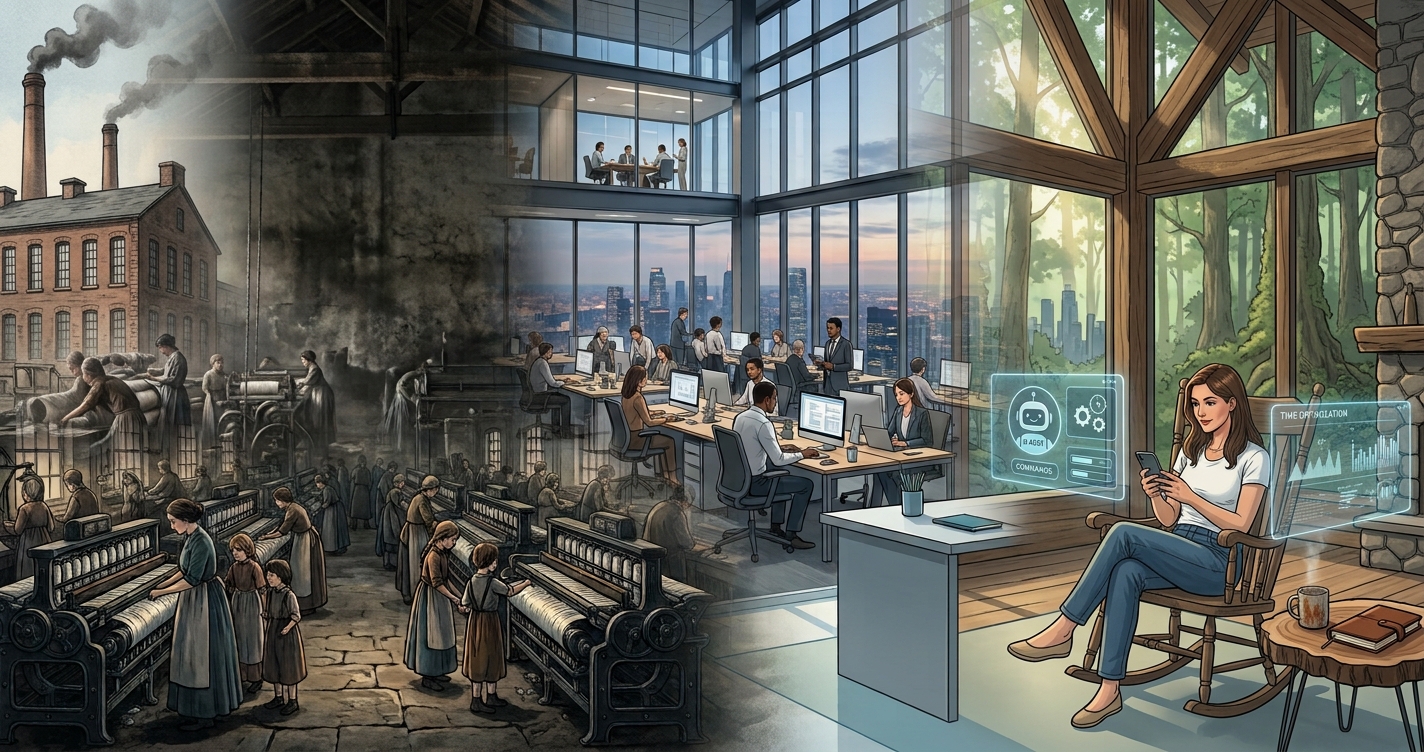
The form of labor we take for granted—'going to a fixed place every day and awaiting instructions'—is merely a 'historical anomaly' of roughly 250 years, forcefully fabricated since the Industrial Revolution in the late 18th century.
Now, a new wave of technological civilization—Artificial Intelligence (AI)—is poised to fundamentally dismantle the 'indoctrination of the company employee' that has persisted for 250 years. This is not a trivial discussion of mere productivity enhancement. The very brutal structure in which the Industrial Revolution stripped humanity of its 'tools' and 'freedom,' transforming individuals into cogs within vast systems, is now on the verge of collapse. In this essay, we will dispassionately unravel the true nature of the 'great transformation, the first in 250 years,' that we are currently facing, drawing upon the historical lessons elucidated by Sven Beckert in his seminal work, Empire of Cotton.
Re-personalization of the Means of Production
The greatest 'transgression' etched by the Industrial Revolution into human history was, in a word, the 'monopolization of the means of production.' In the preceding era of cottage industries, artisans owned looms in their homes, generating wealth with their own skill and tools. For them, tools were an extension of their bodies, the very foundation of their livelihoods.
However, the moment colossal machinery like water-powered spinning frames and steam engines emerged, the rules completely changed. These machines could not fit into individual homes, and only 'capitalists' possessing immense capital could afford to purchase and maintain them. Individuals, stripped of their tools, lost the means to create value independently. The only option left for them to survive was to commodify and sell off their 'time' and 'bodies,' descending into the role of 'laborers' commuting to factories owned by capitalists. This was the archetype of the 'company employee' status that persists to this day.
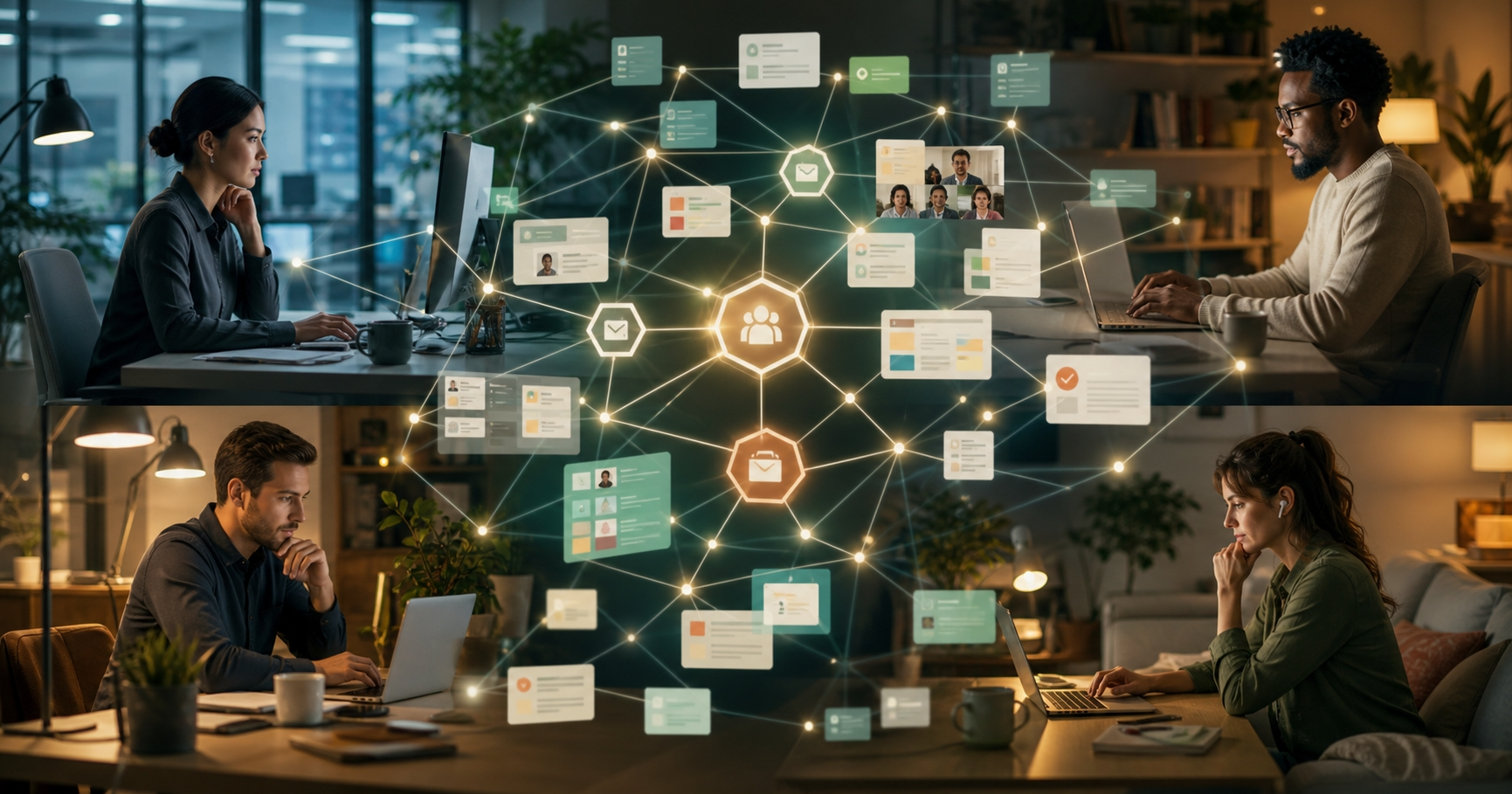
Yet today, the AI revolution is poised to dramatically reverse this 250-year-old master-servant relationship. Previously, operating a cotton factory and dominating global markets required thousands of laborers and immense 'organizations'—human-intensive machines encompassing HR, accounting, marketing, and development to manage them. Now, however, the power to substitute these functions of large corporations is flowing back into the hands of individuals, manifest as a single personal computer or cloud-based AI agents. The 'means of production,' once monopolized solely by capitalists, has been democratized once more as a commodity.
The global surge in 'one-person enterprises leveraging AI' is by no means a transient trend. It represents a historic 'return to cottage industries,' where the previously heavily centralized power of production is reverting to individual hands.
Comparison: Pre-Industrial Revolution vs. AI Revolution Era
| Element of Change | Pre-Industrial Revolution (Cottage Industry) | AI Revolution Era (New Cottage Industry) |
|---|---|---|
| Tools | The 'loom' residing in one's own room. Tools tied to individual physical sensation. | An 'AI agent' within a device. Intelligence that substitutes organizational functions. |
| Location | Home (Space where life and work are undifferentiated) | Not bound by physical location. Home, cafe, while traveling. |
| Pace | Discretionary labor adapted to one's physical condition and family life cycle. | Driving the system by one's own will and managing output. |
| Revenue Structure | Without intermediaries, direct compensation for deliverables. | High-purity value provision, stripped of organizational maintenance costs. |
Equipped with AI, the 'loom of the 21st century,' we have, for the first time in 250 years, the opportunity to break the chains of 'corporate discipline' and truly reclaim mastery over our own lives.
The Vanished Saint Monday
The systems we take for granted, such as 'two days off per week' and '9-to-5 working hours,' were not designed for human well-being, but emerged from the 'managerial imperative' to efficiently operate colossal machinery.
In the era of cottage industries, the initiative in labor rested with the workers themselves. People of that time observed a deeply human custom known as 'Saint Monday.' Upon receiving a week's wages on Saturday night, they would pray on Sunday, and on Monday, they would drink and rest. They would take Tuesday off, often nursing a hangover, finally begin working around Wednesday, and then labor intensely during the latter half of the week to meet their quotas. For them, time was 'material for living their own lives,' not a commodity to be sold to others.
However, the advent of the steam engine stripped away this 'temporal sovereignty.' Operating a colossal steam engine required vast amounts of coal, and once fired up, stopping the machine even for a minute meant all that coal cost became a 'loss.' To avoid these losses, capitalists gathered workers in one place and enforced 'synchronization,' compelling them to work in unison at the pace of the machinery. This led to the invention of the 'factory bell' and 'time card,' with merciless fines imposed for tardiness. It was the moment when humans were demanded to function as 'auxiliary devices for machines,' moving at a constant pace, 24 hours a day, 365 days a year.
The table below illustrates how the transition from cottage industry to factory system fundamentally shattered human working life.
| Element of Change | Cottage Industry (Before) | Factory System with Machinery (After) |
|---|---|---|
| Place of Work | Home (Part of daily life, within the local community) | Factory (Isolated, controlled production space) |
| Basis for Evaluation | Quality and quantity of finished cloth (Results-based) | Constrained 'time' and compliance during that time. |
| Pace of Labor | Adjusted to mood, weather, and season. | Output of the steam engine and speed of machine rotation. |
| Primary Power Source | Human power, livestock, or natural resources. | Water and steam generated by burning coal (Humans as servants of machines) |
| Cost Structure | Low tool maintenance costs (Flexibility) | Enormous fuel costs and capital investment (Stopping is a transgression) |
The AI revolution dismantles this brutal 'After' structure, restoring a flexible form reminiscent of 'Before.' AI consumes no coal, and operating it late into the night incurs no additional costs. By eliminating the need for humans to conform to 'machine demands,' we have, for the first time in 250 years, gained the right to reclaim our 'Saint Monday'.
The Cruel Truth Taught by the Empire of Cotton
In his monumental work, Empire of Cotton, historian Sven Beckert vividly describes how abhorrent and unbearable factory labor was for the people of that era. While we in modern times tend to view 'being employed by a company' as a symbol of stability, for people then, it was synonymous with 'abandoning one's dignity and entering a prison'.
"From sunrise to sunset, sometimes 14 to 16 hours a day. Monotonous tasks were enforced at the pace of the machinery. Factory owners, to transform once free individuals into 'obedient laborers,' established harsh punitive regulations akin to those in a slave prison. Even opening a window was subject to a fine."
Why was the cotton industry central to this transformation? It possessed 'technical characteristics' strikingly similar to modern AI. Wool fibers were complex and varied, difficult for the rudimentary machines of the time to process. In contrast, cotton fibers were strong and uniform. This 'uniformity' was precisely what enabled mechanization and mass production. This bears a strong resemblance to how modern AI thrives on organized 'structured data.' Just as 'uniform raw material' in the form of cotton bound 18th-century humans to organizations, today, digitized 'uniform information' is assimilating our intellectual labor into systems.
The interior of the factories, which the poet William Blake derided as 'Dark Satanic Mills,' was utterly gruesome. Windows were sealed to prevent cotton threads from breaking, and the hot, humid air was thick with fine cotton dust. Workers' lungs were ravaged by disease at a young age. Even more tragic were the children, known as 'scavengers,' who crawled beneath the machines to pick up cotton waste. They navigated beneath moving machinery, and a moment's inattention could lead to them being caught in the gears, costing them their lives or limbs.
Furthermore, factory labor also shattered the 'family order.' Factories did not seek adult men with high skills and pride, but rather children and women who commanded low wages and could 'reach into the gaps of machinery.' Consequently, a perverse social structure emerged where skilled artisan fathers became unemployed, and young children were sent to factories before dawn to support their families.
The roots of the organizations we now call 'corporations' and place our trust in are akin to gravestones built upon the 'thorough negation of humanity' and the 'dismantling of families'.
The Return of Enclosure
Why did people voluntarily step into such brutal, life-depleting factory labor? It was not a voluntary choice, but rather because they were 'structurally coerced'.
In 18th-century Britain, a large-scale expropriation known as 'Enclosure' took place. The common lands previously shared by farmers were seized by landlords under the guise of law and enclosed with physical fences. Farmers, having lost their basis for self-sufficiency, were confronted with the ultimate dilemma: starve to death or drift to the cities and become 'factory slaves'.
And now, we are confronting a 'new enclosure' in the digital realm. The powerful technology of AI is progressively commoditizing (rendering generic) areas that white-collar workers once believed were 'their skills.' Administrative tasks, routine document creation, basic programming... These were once the weapons we used to draw wages from 'organizations,' but now they are being enclosed by AI into tasks that 'anyone can perform, cheaply and quickly'.
18th-century factories, while stripping artisans of their skilled craft, offered an employment alternative: 'you can survive as long as you obey discipline (even if unskilled).' However, the modern AI revolution is even more ruthless. AI agents perform continuously at peak efficiency, 24 hours a day, 365 days a year, without complaint or fatigue. For the first time in human history, the rationale for companies to employ 'individuals with low skills but merely obedient' is on the verge of complete disappearance. Just as farmers were once driven from their land, modern salaried workers are on the cusp of being expelled from the factory-like office by 'the new enclosure of AI'.
A Divided Future
The outcome of the AI revolution is neither a uniform utopia nor a dystopia. Instead, it is a process by which society will be bifurcated into two extreme strata. We now stand before a 'fumi-e' – a decisive test – presented for the first time in 250 years.
The New Neo-Artisan Society
These are individuals who master AI as the 'ultimate tool to entirely replace vast legacy organizations,' driving systems by their own will. For them, AI is not a master to enslave them, but a 'transparent subordinate' for realizing their own visions. They are the segment returning to become 'masters of time,' discarding 'relics of the Industrial Revolution' like crowded trains and pointless meetings, and instead investing their time in inherent human creativity and profound relationships.
Loss of Functional Value
Conversely, those unable to escape the 250-year-old factory model mindset of 'executing instructions precisely' and 'commodifying their time' will face an extremely severe reality. The 'functional value' they provide will be utterly defeated in price competition with AI. Historically, such strata might either attempt resistance, like the 19th-century 'Luddite movement (machine smashing),' or, through public distribution mechanisms like 'Universal Basic Income,' they could converge into 'domesticated entities'—economically 'unproductive' but responsible solely for 'consumption activities' to maintain the system.
AI liberates us from 'organizations,' but simultaneously denies us 'survival merely through obedience.' While 'discipline' was the condition for survival 250 years ago, from now on, 'autonomy' will be the sole condition for survival.
Conclusion
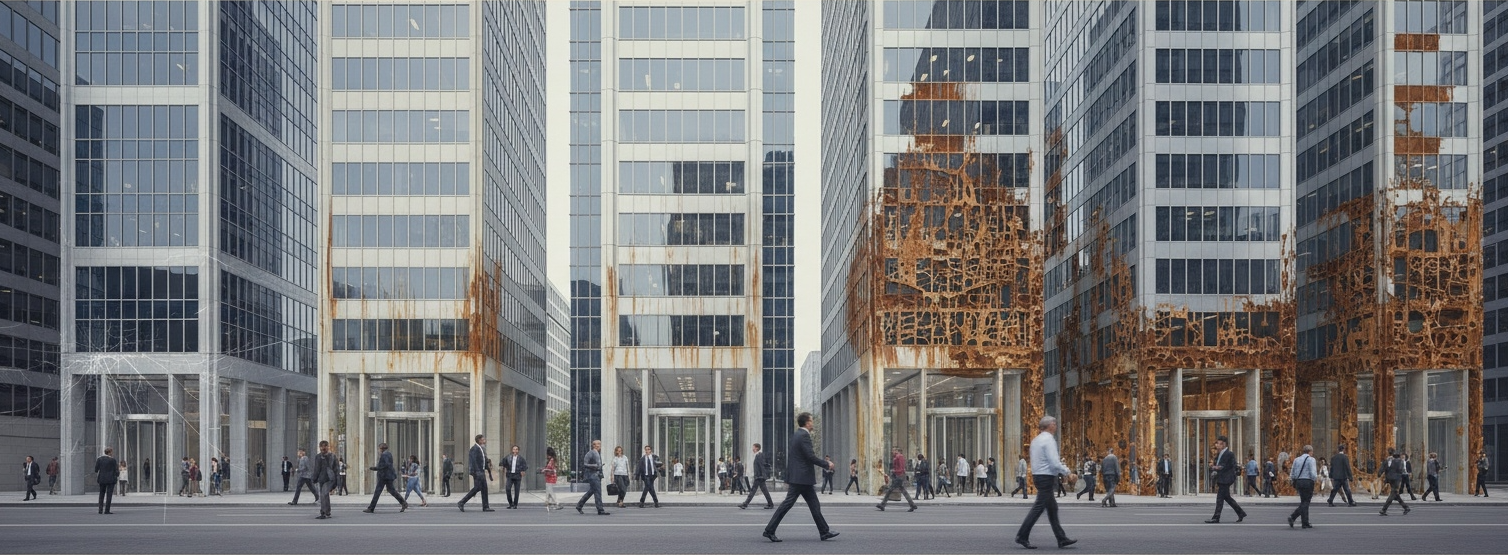
We are currently in a historical transitional period where the 'indoctrination called company,' which lasted for 250 years, is unraveling.
Gathering at the same place at the same time every morning. Performing fragmented, divided tasks while gauging the boss's mood. These actions are merely remnants of the 'factory model,' coercively imposed on free individuals to efficiently operate the colossal and unwieldy machinery of the steam engine. Technology has now, once again, endowed us with the power to liberate ourselves from those unnatural constraints.
However, this 'liberation,' while offering 'freedom,' also presents a 'solitary struggle.' Upon re-acquiring the weapon of the means of production, we must transform ourselves into 'artisans who drive systems by their own will.' If we remain accustomed to being managed by others, we will merely become 'discarded' unemployed individuals, lost and adrift after being expelled from the factory-like office.
What we face is not merely a choice of working style. "Will we revert to being 'humans' who master tools and live by their own time?" "Or will we settle for being mere 'cogs,' sustained and domesticated by the system?"
A human-historical level 'redistribution of the means of production' has arrived for the first time in 250 years. Faced with this historic opportunity, what decision will you make about how to live? The doors of the factory named 'office' are already open. The time to step outside and reclaim the initiative over your own life has already begun.