
Key Takeaways (TL;DR)
- It was the 9th head of Yamamotoyama who formalized the combined sales model of tea and nori in 1947.
- The commonality of management requirements, such as humidity control and drying, enabled the transfer of know-how for quality maintenance.
- The seasonal misalignment between tea (spring/summer) and nori (winter) greatly contributed to the leveling of sales and cash flow.
1. Introduction
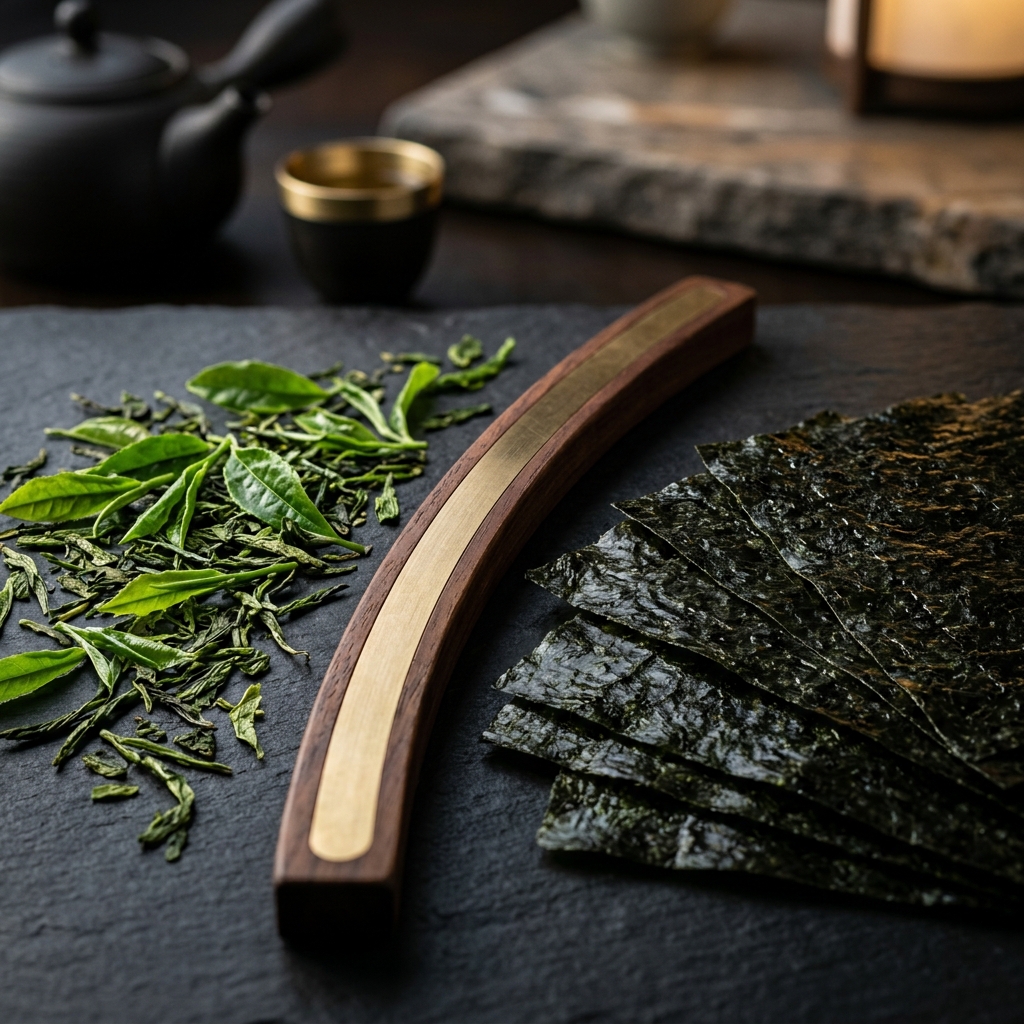
It is common to see "nori" (seaweed) sold in Japanese tea retail stores. At first glance, they appear to be completely different products, one from the mountains (tea leaves) and one from the sea (nori), but in the history of Japanese retail business, there has been no other combination that has created such a rational and perfect synergy. This paper examines how the co-selling of tea and nori began and became established, its historical background, and business rationale, and discusses lessons applicable to modern new business development.
2. Historical Background and Establishment of the Co-selling Model
2.1 History of Tea and Nori Retail
Tea spread after the Kamakura period, and when the method for making "sencha" (green tea) was developed in the Edo period, it rapidly became popular among common people. Many "chasho" (tea merchants) existed in Edo, and branding progressed. Meanwhile, the manufacturing technology for "kan-nori" (dried seaweed sheets) as we know it today was established in the mid-Edo period, becoming a staple Edo souvenir known as "Asakusa Nori," and was mainly sold by nori wholesalers and dried goods stores.
2.2 History of Tea and Nori Co-selling at Yamamotoyama
A representative store that clearly linked tea and nori and established the "co-selling model" that continues to this day is the long-established "Yamamotoyama," founded in Tenpo 2 (1831). According to the company's official records, it was shortly after the war, in 1947 (Showa 22), during the era of the 9th generation owner, that the full-scale sale of nori actually began.
There are three historical facts behind the company, which had been a tea specialist for over 250 years, entering the nori business:
- The owner's personal inspiration: The first impetus was when the 9th generation owner ate high-quality nori from the Ariake Sea at a traditional Japanese restaurant, was deeply moved by its deliciousness, and thought, "I want to deliver this wonderful Japanese taste to more people, just like tea."
- Wartime business crisis (tea rationing system): During the chaotic period of and after the war, tea became subject to a government-controlled "rationing system," making free trade impossible. As the company faced a critical situation, almost shutting down, there was an urgent need for "another pillar not solely reliant on tea."
- Seasonal difference (conviction about peak seasons): While the peak season for tea is spring (new tea), the peak season for nori is winter (new nori). The conviction that "if we could offer customers two different 'peak seasons' within a year, we could create a wonderful business cycle" encouraged entry into manufacturing and sales.
3. Business Rationale for the Co-selling Model
Behind the success of the tea and nori combination lies strong business rationale: "commonality of management requirements" and "seasonal differences."
3.1 Commonality of Management Requirements (Assets and Know-how)
For both tea and nori, the greatest enemies to quality preservation are "moisture" and "oxygen (oxidation)." Moisture-proof technologies used for storing tea, such as "tea canisters" and "paulownia wood boxes," could be directly applied to nori storage. Furthermore, "roasting" to bring out the aroma of tea leaves and "baking (drying)" nori share common processes. At Yamamotoyama, the "know-how for firing tea leaves," cultivated over 200 years, was splendidly elevated into the technology for deliciously roasting nori.
3.2 Smoothing Sales and Cash Flow through Seasonal Differences
Tea, an agricultural product, and nori, a marine product, have opposite harvest and peak seasons. From spring to summer, tea (new tea, O-chugen demand) drives sales, while in winter, nori (new nori, O-seibo demand) reaches its peak. This made it possible to completely smooth out the store's annual operating rate, sales, and cash flow.
3.3 Contribution to Retail Store Sales and Profits
In Japanese food culture, "tea" and "rice (rice + nori)" are often paired at the dining table, naturally inducing impulse purchases (cross-selling). Furthermore, by monopolizing the demand for high-priced gift items throughout the year—tea in summer and nori in winter—they maximized sales and profit margins per store area without increasing fixed costs.
4. Lessons for New Business Development
The successful case of a tea shop selling nori serves as a "textbook example of synergy" in modern new business development, offering the following three lessons:
4.1 Seek Transferable Applications for "Core Competencies (Strengths)"
Instead of venturing into unknown territories, by seeking markets where existing infrastructure and know-how—such as moisture-proof storage, drying technology, and gift distribution networks—can be directly utilized, companies can reduce investment risk and increase the probability of success.
4.2 Fill "Resource Idle Time (Surplus Time and Space)"
By combining products where the off-season for one main product becomes the peak season for another, fixed costs can be diluted, and year-round business stability (revenue management) can be achieved.
4.3 Expand within the Customer's "Series of Experiences (Context)"
Just as it was accepted without psychological friction within the customer's lifestyle habit of "Japanese dining," designing horizontal expansion based on consumption scenes and contexts creates true customer engagement.
5. Conclusion
The felicitous marriage of tea shops and nori is an excellent example of a timeless business model that possesses the three key elements for new business success: "asset commonality," "timeline complementarity," and "customer context alignment." As the Yamamotoyama case demonstrates, while triggered by external environmental changes such as a business crisis, the perfect alignment of "the owner's personal inspiration" and "the business rationality of complementing seasonality" has allowed this model to maintain strong competitiveness to this day.